

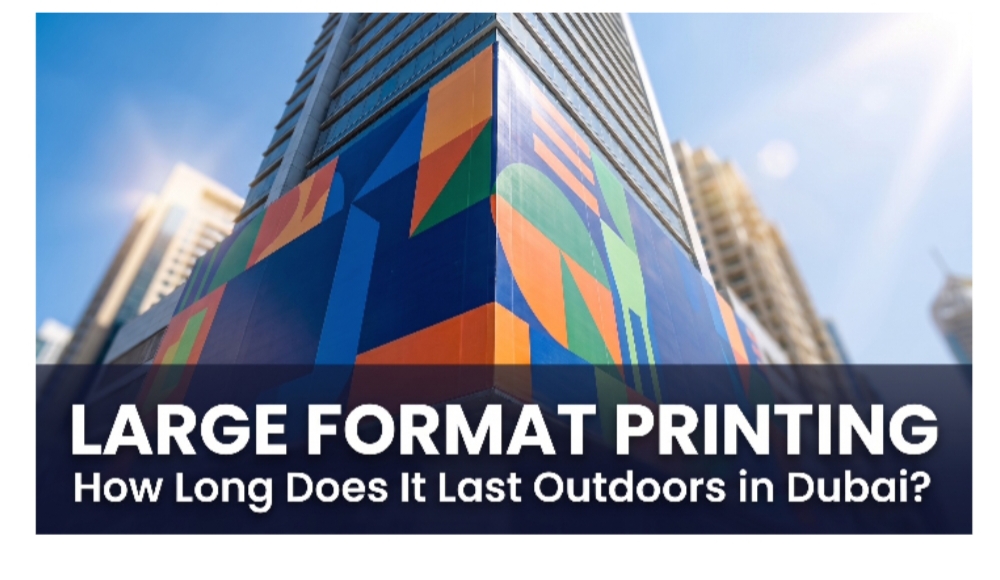
Most businesses commissioning outdoor graphics in Dubai focus on the design and the cost. The question they rarely ask upfront — but almost always ask six months later — is how long it will actually last. The answer depends entirely on the material specification. Get it right and an outdoor sign holds its colour and surface quality for years. Get it wrong, and the same sign is visibly degraded before the first year is out.
Large format printing in Dubai’s outdoor environment faces a specific combination of stresses that most markets do not. UV radiation here is classified as extreme — regularly hitting index levels of 11 and above. Summer surface temperatures on metal and glass building facades exceed 70 degrees. Coastal salt air affects materials across significant parts of the city. Each of these factors degrades outdoor print materials at a rate that surprises buyers accustomed to milder climates.
Understanding how long different materials actually last in Dubai’s outdoor conditions — and why the differences exist — helps businesses make better specification decisions before the print job is commissioned rather than after it has already failed.
Why Dubai’s Climate Is Harder on Outdoor Print Than Most Markets
The starting point is understanding what UV radiation actually does to print materials. UV light breaks down the polymer chains in both the substrate and the ink — a process called photodegradation. The visible result is color fading, surface chalking, and increasing brittleness in the material. In a European climate with a UV index peaking at 6 to 8, this process is slow. In Dubai at a UV index 11 and above, it is significantly faster.
Temperature cycling compounds the problem. Materials expand in Dubai’s summer heat and contract in cooler winter months. Over repeated cycles, materials that lack dimensional stability develop micro-cracks, delaminate from the surfaces they are applied to, and fail at fixings and joins.
The practical consequence is that materials specified for outdoor use in other markets often underperform significantly in Dubai — not because they are poor quality products, but because they were not designed for this specific combination of environmental stresses.
How Long Different Materials Last Outdoors in Dubai
Cast Vinyl with UV-Curable Inks — 3 to 7 Years
Cast vinyl with UV-curable or UV-resistant inks is the standard outdoor large format printing specification for flexible substrates in Dubai. It is used for building wraps, vehicle graphics, retail window graphics, and outdoor advertising panels across the UAE.
The service life of quality cast vinyl with correct ink specification and outdoor overlamination in Dubai’s outdoor conditions is 3 to 7 years — significantly longer than calendared vinyl equivalents, which typically show visible degradation within 12 to 18 months under the same conditions.
The distinction between cast and calendared vinyl matters more in Dubai than in most markets. Calendared vinyl shrinks as temperatures rise — a consequence of the internal stress built into the manufacturing process. In Dubai’s summer heat, this shrinkage causes edges to lift, graphics to pull away from surface joins, and vehicle wraps to retreat from body panel curves. Cast vinyl has no internal stress and remains dimensionally stable through Dubai’s temperature extremes.
Aluminum Composite Panel with Direct UV Print — 7 to 15 Years
For rigid outdoor signage — building fascias, hoarding panels, and permanent outdoor display structures — aluminum composite panel with direct UV flatbed printing delivers the longest service life available in Dubai’s outdoor large format printing market.
The ACP panel itself handles Dubai’s outdoor conditions exceptionally well. The polyethylene core absorbs thermal expansion and contraction. The aluminum faces resist corrosion and UV degradation. Direct UV printing bonds ink directly to the panel surface — producing a graphic that is effectively part of the substrate rather than a separate layer that can delaminate or lift.
For a branding company in Dubai specifying permanent outdoor signage that needs to look as good at year ten as it did on installation day — ACP with direct UV print is the correct specification.
Mesh Vinyl — 2 to 3 Years in Exposed Locations
Large outdoor banners in wind-exposed locations — building scaffolding, construction hoarding fences, and rooftop structures — face mechanical stress that solid vinyl cannot handle. A solid vinyl banner acting as a full-surface sail in Dubai’s coastal winds fails at the fixings and tears along the edges within months.
Mesh vinyl is perforated — allowing wind to pass through rather than pushing against the full surface. The service life in exposed outdoor Dubai locations is 2 to 3 years with correct UV-rated ink specification. This is shorter than ACP or cast vinyl in sheltered applications, but significantly longer than solid vinyl in the same exposed conditions.
Backlit Film — 2 to 4 Years Outdoors
Illuminated outdoor advertising structures — lightboxes and backlit pylon sign faces — require outdoor-rated backlit film rather than standard opaque vinyl. Standard indoor backlit film yellows within weeks of outdoor UV exposure in Dubai — changing the colour balance of the printed graphic and reducing the lightbox’s illuminated output.
Outdoor-rated UV-stabilized backlit film maintains colour accuracy through sustained UV exposure and handles the internal heat of an illuminated cabinet in Dubai’s summer conditions. Service life for quality outdoor backlit film in Dubai is 2 to 4 years before significant colour shift becomes visible.
What Shortens Service Life — The Specification Mistakes That Cost More Later
Understanding what actually degrades outdoor large format printing in Dubai faster than necessary helps businesses avoid the most common and expensive specification mistakes.
Using calendared vinyl instead of cast vinyl — the most common mistake in outdoor flexible print applications. The cost difference between cast and calendared vinyl is modest. The service life difference in Dubai’s conditions is not.
Standard aqueous inks instead of UV-curable inks — aqueous inks are designed for indoor applications. Under Dubai’s outdoor UV exposure, they begin visibly fading within weeks. UV-curable inks bond at a molecular level to the substrate and resist UV degradation significantly better.
Skipping over lamination — outdoor-rated overlaminate adds UV protection, scratch resistance, and moisture resistance simultaneously. In Dubai’s outdoor conditions, it can effectively double the service life of the substrate beneath it. Treating it as optional is a false economy.
Not accounting for the installation surface — the surface a graphic is applied to affects its service life as much as the material specification. A correctly specified cast vinyl graphic on an incorrectly prepared or incompatible surface fails prematurely regardless of the material quality.
Service Life Summary for Dubai Outdoor Applications
MaterialApplicationService Life in DubaiCast vinyl, UV inks, laminateBuilding wraps, vehicle graphics3 to 7 yearsACP with direct UV printRigid fascia and hoarding signage7 to 15 yearsMesh vinyl, UV inksExposed outdoor banners2 to 3 yearsOutdoor backlit filmIlluminated lightboxes2 to 4 yearsCalendered vinyl, standard inksNot recommended for Dubai outdoorUnder 18 months |
