

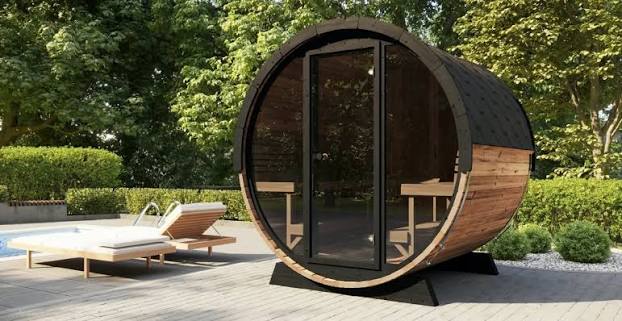
Canadian summers are warm but short, and even in the height of the season the evenings by a lake or on an acreage can turn cool the moment the sun drops. That rhythm has quietly made backyard heat therapy a year-round habit rather than a winter one, and it explains why the rounded wooden cabin in the corner of so many properties keeps its appeal through July and August.
The shape that draws the eye is also the reason it works, because abarrel saunaearns its performance from geometry, wood chemistry, and airflow long before any heater is switched on.
A round cross-section refuses to be crushed
The barrel form is not a styling flourish. A circle is one of the strongest shapes in construction because a load pressing on it is carried as compression running around the curve, rather than as a bending force trying to snap a flat panel.
Picture leaning on the middle of a straight plank against pushing on the side of a solid log. The plank flexes and eventually fails, while the log simply passes the force through itself. The curved wall of a sauna works the same way, turning wind pressure, rain, and its own weight into gentle compression that the timber shrugs off.
Curved staves and steel bands lock the shell together
The wall is built from many narrow curved boards, called staves, set edge to edge around the circumference. On their own they would fall apart, so several steel tension bands wrap the outside and cinch every stave inward toward the center.
This is the same principle a cooper has used on wine and whiskey casks for centuries. Each band squeezes the staves so tightly that the joints seal under pressure, and the harder the structure is pushed from outside, the more firmly the wood is pressed together. As the cedar takes on a little moisture it swells slightly, closing the seams even further without any glue at all.
The load path inside a barrel sauna is worth stating plainly:
•Steel bands: pull staves inward under constant tension
•Curved staves: carry weight as compression, not bending
•Swelling wood: tightens seams as humidity rises
•Round roof: sheds rain and snow without flat spans
Cedar earns its place by managing moisture
Western red cedar is chosen for far more than its warm color and scent. The wood carries natural oils that resist rot and discourage the mold and insects that would attack ordinary lumber in a warm, damp box heated day after day.
Cedar is also dimensionally stable, meaning it swells and shrinks less than most species as humidity rises and falls. That stability keeps the staves fitting neatly through countless heating cycles, so the shell does not loosen or crack. On top of that, the wood is light and full of tiny air pockets, which makes it a natural insulator that stays comfortable to touch even when the air inside is scorching.
Heat rises, and the curved wall puts it to work
Warm air is less dense than cool air, so it climbs. Inside any heated room the temperature stacks in layers, hottest near the ceiling and coolest at the floor, a pattern known as stratification.
A rounded ceiling uses this to its advantage. Where a square room traps cool, stagnant air in its upper corners, the curve guides rising heat smoothly over the occupants and back down along the walls, keeping the warmth circulating. The smaller enclosed volume of the barrel also means less air to heat, so the room reaches temperature faster and recovers quickly after the door opens.
Bench height is set with the same physics in mind. Sitting higher places a bather in the hotter upper layer, while the lower bench offers a milder seat, letting three people share one small space at the intensity each prefers.
Fresh air is designed in, not left to chance
A sealed hot box would quickly grow stale and starve its heater, so ventilation is built into the plan. A low intake near the heater lets cool, oxygen-rich air enter, where it warms, rises, and pushes older air out through an adjustable upper vent on the far side.
This slow convection loop matters for comfort and for safety, refreshing oxygen and carrying away excess humidity so the room feels clean rather than smothering. The controls are simple, but they turn the whole cabin into a managed airflow system.
The details that make a session pleasant come together here:
•Low intake: draws cool air toward the heater
•Upper vent: releases stale, humid air outside
•Tempered glass door: resists heat and sudden knocks
•Tiered benches: match seat height to preferred warmth
The heater and its stones stretch the warmth
At the core of any barrel sauna sits the heater, and the pile of stones resting on it does quiet but essential work. Those rocks are dense thermal mass, absorbing energy from the element and then radiating it steadily into the room long after the heater cycles down.
This is why a session feels so different from standing beside a simple space heater. Much of the warmth reaching the body is radiant heat traveling in straight lines from the hot stones and timber, the same way the sun warms skin on a clear day, rather than only the heated air passing by. Pouring a ladle of water over the stones flashes it to vapor, lifting the humidity in a brief wave that makes the fixed air temperature feel far more intense.
The mass of the stones also smooths out the experience. Instead of sharp swings each time the element switches on and off, the stored heat buffers the room, holding a steady radiant glow that a thin metal box could never sustain.
A level base keeps the shell true
A barrel sauna concentrates its weight onto the two curved cradles it rests upon, so the ground beneath them has to be firm and level. Set on soft or uneven soil, the shell can rack out of round, and staves that no longer meet squarely will let heat and steam leak at the seams.
A compacted gravel pad or a set of solid piers spreads the load and keeps water from wicking up into the end walls. Getting the base right before the first fire protects both the fit of the wood and the life of the steel bands that hold everything in compression.
Seen as a whole, none of these features is decorative. The round shell, the banded cedar staves, the heated stones, and the vents each answer a specific demand of holding heat safely outdoors, which is exactly why the design has survived so long.
For anyone weighing one for a Canadian backyard, understanding a barrel sauna as a piece of structural and thermal engineering makes it far easier to judge quality and to use it well.
