

The Growing Demand for Flexible Short-Range Connectivity
In today’s network environments, not every connection requires high-speed fiber or long-distance transmission. Many enterprise networks, small business infrastructures, and even data centers still rely heavily on short-range links, typically within 100 meters. These connections are often used to link switches, routers, servers, and end devices within the same room or building. In such scenarios, choosing the right type of transceiver is less about maximum speed or distance and more about flexibility, cost efficiency, and ease of deployment. This is where 1G SFP modules continue to play a significant role, especially for networks that prioritize stability and compatibility over cutting-edge performance.
At the same time, network upgrades are not always about replacing everything with fiber. In many cases, existing copper cabling infrastructure, such as Cat5e or Cat6 Ethernet cables, is already in place and fully capable of supporting Gigabit Ethernet. Rather than investing in new fiber installations, organizations often look for ways to extend the life of their current systems. This is another reason why 1G SFP modules remain relevant, as they provide a bridge between modern SFP-based devices and traditional RJ-45 copper connections without requiring major infrastructure changes.
What Is a 1000BASE-T SFP Module?
Bridging SFP Ports and RJ-45 Ethernet
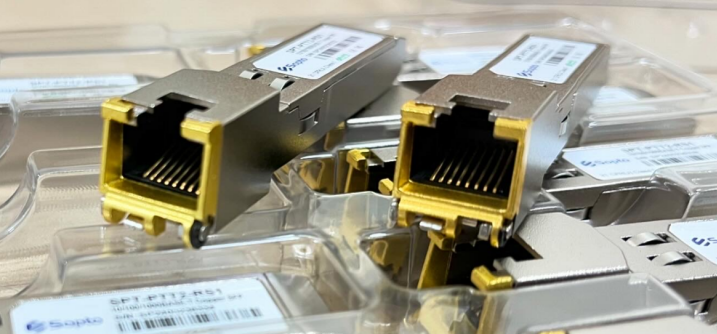
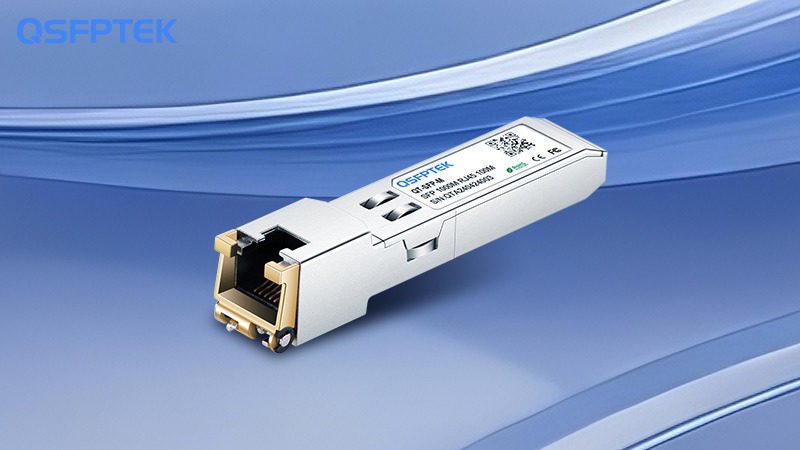
A 1000BASE-T SFP copper module is a transceiver designed to convert electrical signals from an SFP port into standard Ethernet signals that can be transmitted over twisted-pair copper cables. Unlike optical modules that rely on light signals and fiber optics, this type of module operates entirely on electrical signaling, making it compatible with widely used RJ-45 connectors. It supports transmission distances of up to 100 meters over Cat5e or higher cabling, which aligns perfectly with the requirements of most local area networks.
Designed for Simplicity and Compatibility
One of the key advantages of 1000BASE-T SFP modules is their simplicity. Because they use standard Ethernet cabling and connectors, they can be easily integrated into existing network setups. There is no need for specialized fiber patch cords, cleaning procedures, or additional training for installation. This makes them particularly attractive for environments where ease of use and quick deployment are priorities.
Why 1000BASE-T SFP Excels in Short-Range Applications
Maximizing Existing Copper Infrastructure
One of the most compelling reasons to use 1000BASE-T SFP modules is their ability to leverage existing copper cabling. Many buildings are already wired with Ethernet cables, and replacing this infrastructure with fiber can be both costly and disruptive. By using copper SFP modules, organizations can upgrade their network equipment while continuing to use the same cabling. This approach significantly reduces capital expenditure and simplifies the upgrade process.
Cost-Effective Solution for 100m Links
For short-range connections, cost is often a deciding factor. Optical modules, along with their associated fiber cables, tend to be more expensive than copper-based solutions. In contrast, 1000BASE-T SFP modules provide a more economical alternative without sacrificing performance for distances up to 100 meters. This makes them an ideal choice for connecting devices within the same rack, office, or floor, where long-distance capabilities are unnecessary.
Easy Deployment and Maintenance
Another advantage of copper SFP modules is the ease of installation and maintenance. Ethernet cables are familiar to most IT professionals, and their plug-and-play nature reduces the risk of errors during deployment. Additionally, copper connections are generally more robust in everyday handling compared to fiber, which can be sensitive to bending, dust, and connector contamination. This makes 1000BASE-T SFP modules particularly suitable for environments where frequent changes or reconfigurations are expected.
Performance Considerations in Real Deployments
Reliable Gigabit Speeds for Everyday Applications
While 1000BASE-T SFP modules are limited to Gigabit speeds, this level of performance is sufficient for many common applications, including office networking, IP surveillance, and basic data center connectivity. For organizations that do not require higher bandwidth, these modules provide a stable and reliable solution that meets their needs without unnecessary complexity.
Power Consumption Trade-Offs
It is important to note that copper SFP modules typically consume more power than their optical counterparts. This is due to the electrical processing required to support Ethernet signaling over twisted-pair cables. In high-density switch environments, this increased power consumption can become a consideration. However, for smaller deployments or networks with moderate port usage, the impact is usually manageable and outweighed by the benefits of cost savings and flexibility.
When to Choose 1000BASE-T SFP Over Fiber
Ideal for Short Distances and Existing Cabling
The decision to use 1000BASE-T SFP modules is most straightforward when dealing with short-distance links and existing copper infrastructure. In these cases, the benefits of lower cost, easier installation, and compatibility with standard Ethernet cables make them a natural choice. Fiber solutions, while offering higher performance and longer reach, may introduce unnecessary complexity for such applications.
Not Suitable for High-Speed or Long-Distance Needs
On the other hand, copper SFP modules are not designed for high-speed or long-distance transmission. Networks that require 10G, 25G, or higher speeds, or those that need to span distances beyond 100 meters, will benefit more from fiber-based solutions. Understanding these limitations is essential to making the right deployment decision and avoiding performance bottlenecks.
Final Thoughts: A Practical Choice for Everyday Networking
The 1000BASE-T SFP copper RJ-45 100m transceiver module stands out as a practical and efficient solution for short-range network connections. Its ability to integrate seamlessly with existing copper infrastructure, combined with its cost-effectiveness and ease of use, makes it an ideal choice for a wide range of applications. While it may not offer the speed or distance of fiber-based alternatives, it excels in scenarios where simplicity, flexibility, and affordability are the primary concerns.
In real-world deployments, the value of a solution is often determined by how well it aligns with actual network requirements rather than theoretical performance. For many organizations, 1000BASE-T SFP modules strike the right balance, delivering reliable Gigabit connectivity without unnecessary complexity. As a result, they continue to play an important role in modern networking, particularly in environments where short-range copper connections remain the most practical option.
